

The Explosive Weapons Monitor report on 2025 has proven once again that civilians bear the brunt of conflict. Read the report to get the full picture of how civilians were impacted by the use of explosive weapons in populated areas (EWIPA) in 2025.
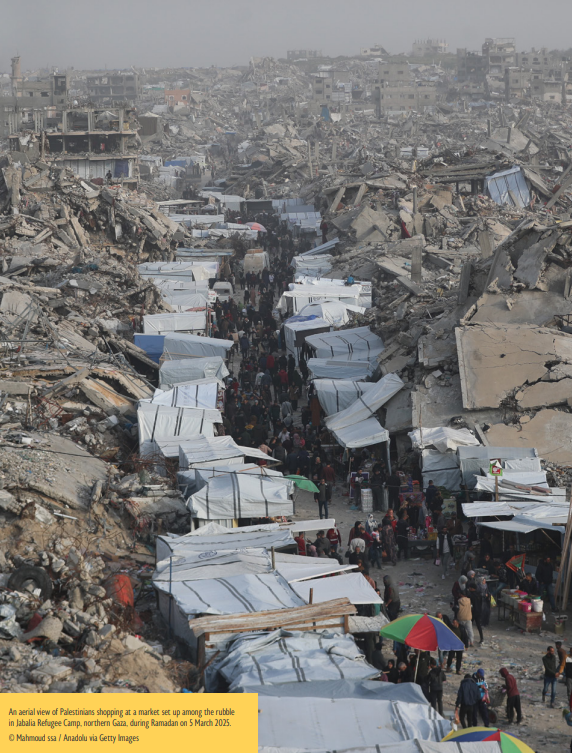
In 65 countries around the world, more than 22,600 civilians were killed by explosive weapons being used in populated areas. State armed forces were responsible for 85% of all incidents in which civilians and civilian infrastructure were impacted by the use of EWIPA. In particular, 56% of all recorded civilian deaths were caused by Israeli armed forces, mostly from their ongoing genocide in Palestine. 12 other countries were severely impacted by EWIPA: Democratic Republic of Congo, Ethiopia, Iran, Iraq, Lebanon, Myanmar, Somalia, South Sudan, Sudan, Syria, Ukraine, and Yemen.
Attacks against humanitarian aid, education, and healthcare continued:
- At least 2,541 incidents of attacks which affected aid operations were recorded in 17 countries, marking an increase of 52% since 2025.
- Gaza continues to be the most dangerous environment for aid workers, with 156 incidents against aid operations recorded in 2025 alone.
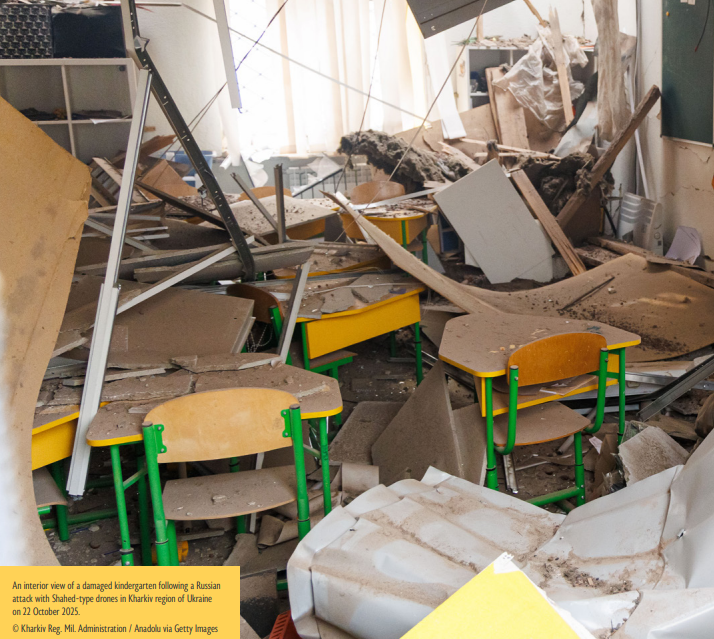
- At least 1,416 incidents of attacks which destroyed or damaged education facilities or killed teachers were recorded in 27 countries, marking a 65% increase from 2024.
- More than 3,800 schools have been impacted by explosive weapons in Ukraine since the start of Russia's illegal invasion.
- At least 1,272 incidents which affected health facilities, ambulances, or killed healthcare workers were recorded in 22 countries and territories, marking a geographic spread with new incidents in Ecuador, South Sudan, and Thailand.
- In Syria, incidents against healthcare decreased by 63% during the first year of the interim government however after years of conflict, health systems are struggling to recover.
This does not need to be an accepted reality of conflict. All states are legally required to avoid harming civilians and civilian infrastructure. It is imperative that states are held accountable for the alarmingly high and completely unacceptable amount of civilian harm that is being caused by their use of explosive weapons in populated areas. But how can we hold them accountable?
The 2022 Political Declaration on Explosive Weapons in Populated Areas provides a strong framework for reducing harm to civilians and is the first formal international recognition that EWIPA needs to be addressed by states. As the Explosive Weapons Monitor notes, it is a practical tool that requires effective national-level implementation. The report has four key recommendations for states:
- Publicly acknowledge and call for action to address the harm to civilians and communities resulting from the use of explosive weapons in populated areas.
- Endorse the Declaration and encourage endorsement by other states.
- Review, revise, or develop new national policy and practice.
- Promote, support, and utilize the diversity of stakeholders engaged in work around the Declaration.
We need to keep pushing our government representatives to take these issues seriously and make a change. Canada has endorsed the Political Declaration, but needs to be pushed by Canadians to effectively implement it.
Reach out to your Member of Parliament sharing a copy of the new Explosive Weapons Monitor report, calling on them to push Canada to put the Declaration into action. You can also donate to Mines Action Canada to support our work advocating against the use of explosive weapons in populated areas.
Thank you to the team at Explosive Weapons Monitor for their hard work to release this report.
Do you like this page?