

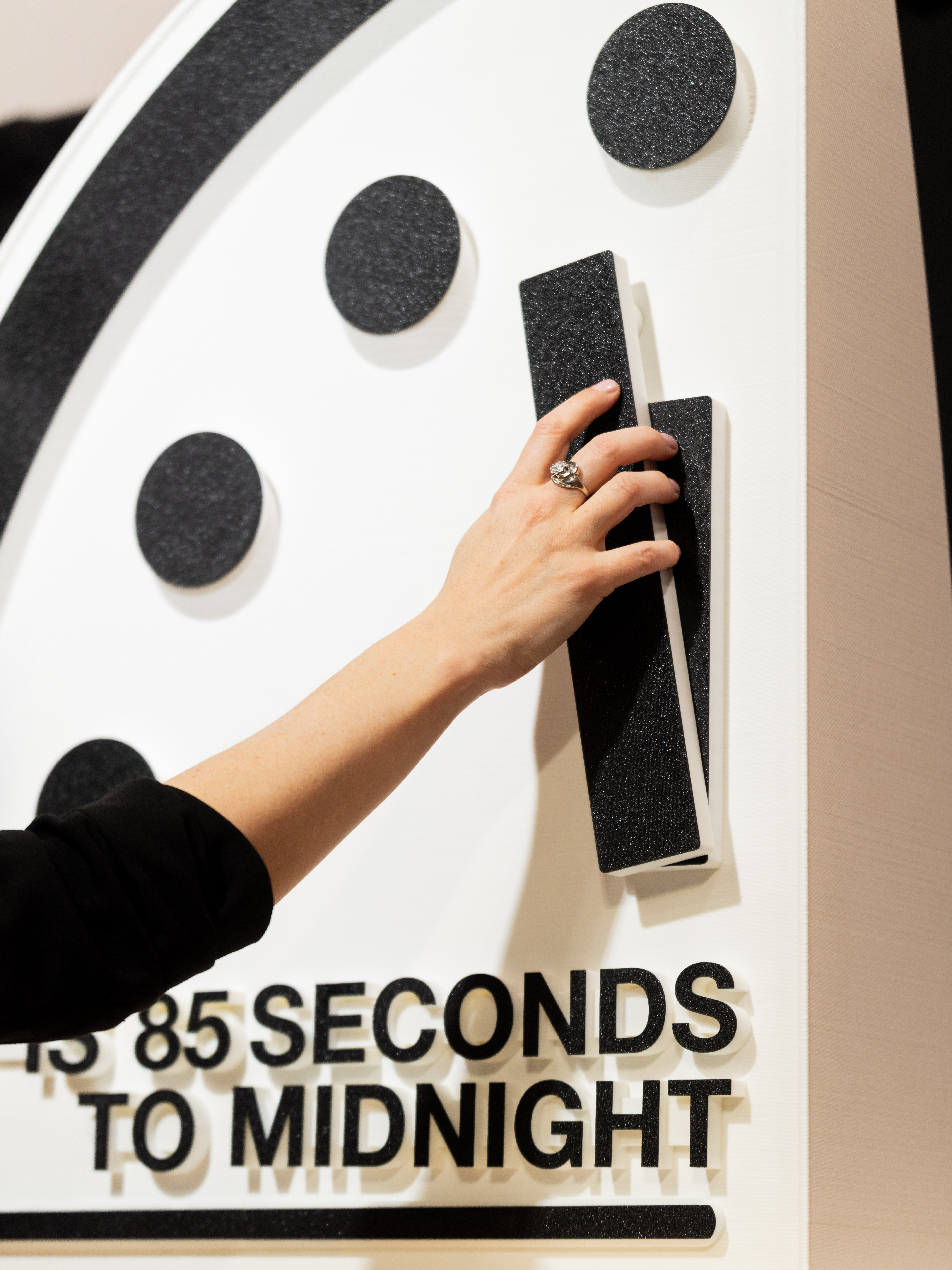
On January 27, the Bulletin of the Atomic Scientists urged world leaders to recognize that their actions are leading us closer to nuclear war by setting the Doomsday Clock to 85 seconds to midnight. This is a clear message that we need to reverse our path, and instead take action towards peace and stability. First, let's understand what the Doomsday Clock really means and then we will tell you how you can help Canada can rewind the clock!
What is the Doomsday Clock?
The Doomsday Clock was created in 1947 as a signal for how close humanity is to destroying itself with our own technologies. At the time, the Doomsday Clock was focused on nuclear weapons, but it has now grown to include the threat of climate change and artificial intelligence. It is a stark reminder for world leaders to consider how the decisions they make can lead to disaster. This four minute YouTube video gives an excellent history of the Doomsday Clock:
Who sets the time?
The Bulletin of the Atomic Scientists, whose mission is to equip "the public, policymakers, and scientists with the information needed to reduce man-made threats to our existence." Since 2008, the Science and Security Board of the Bulletin of the Bulletin of the Atomic Scientists has had the responsibility to set the hands of the Doomsday Clock. The board is made up of globally recognized experts in nuclear risk, climate change, and new technologies.
Why did they it to 85 seconds to midnight?
The 2026 Doomsday Clock statement says: "A year ago, we warned that the world was perilously close to global disaster and that any delay in reversing course increased the probability of catastrophe. Rather than heed this warning, Russia, China, the United States, and other major countries have instead become increasingly aggressive, adversarial, and nationalistic. Hard-won global understandings are collapsing, accelerating a winner-takes-all great power competition and undermining the international cooperation critical to reducing the risks of nuclear war, climate change, the misuse of biotechnology, the potential threat of artificial intelligence, and other apocalyptic dangers. Far too many leaders have grown complacent and indifferent, in many cases adopting rhetoric and policies that accelerate rather than mitigate these existential risks."
What can we do about it?
This is the most important question. The time set in the clock is not set in stone - it can, and has been reversed. In 1991, when the Cold War ended, the clock was reversed to 17 minutes from midnight after being set at 10 minutes to midnight in 1990.
The only credible way to permanently move the hands back is to stigmatize, prohibit, and eliminate nuclear weapons through the Treaty on the Prohibition of Nuclear Weapons (TPNW). Near term risk-reduction measures that include renewed arms reduction agreements (including bilateral agreements), a return to transparency, and stopping proliferation rhetoric, can also build momentum towards the TPNW. You can advocate for this by reaching out to your Member of Parliament today and asking them to sign the Parliamentary Pledge committing to TPNW.
Many Canadian Parliamentarians have already signed this Pledge, and in 2010, a unanimous motion passed in Parliament in support of nuclear disarmament. Canadians want nuclear disarmament - so why hasn't Canada joined the only Treaty that bans them? We need every Canadian to push our government towards this safer path, and help reverse the hands of the Doomsday Clock.
As the Executive Director of the International Campaign to Abolish Nuclear Weapons, Melissa Parke, says “The Doomsday Clock is not a prediction, it’s a warning. Nuclear weapons, wars from Ukraine to Gaza, the climate crisis and runaway technologies are all part of the problem – but they are all created by humanity. That means we can also change course. The Treaty on the Prohibition of Nuclear Weapons (TPNW) is a clear path to turn back the hands of the clock."
Canada, head this warning and help rewind the clock! Reach out to your Member of Parliament today and urge them to sign the Parliamentary Pledge on the TPNW.
Do you like this page?