

Written by Ralph Mbanzabugabo, International Development and Globalization student at the University of Ottawa
Landmines continue to kill and injure long after conflicts end—but their impact extends beyond human casualties. Across contaminated regions, wildlife is injured or killed, habitats are fragmented, and ecosystems remain disrupted for decades. For example, in Cambodia, one of the most heavily contaminated countries in the world, minefields overlap with biodiversity-rich environments, increasing risks to wildlife while limiting conservation efforts. These environmental consequences are often overlooked, despite their significant, prolonged impacts on biodiversity, land use, and post-conflict recovery.

Elephant landmine victim from Thailand, Mosha, with a new prosthetic leg.Mosha was 7 months old when she stepped on a landmine along the Thai-Myanmar border. Photo from Athit Perawongmetha/REUTERS.
The impact of landmines on wildlife is both direct and long-lasting. Animals are frequently injured or killed by explosive remnants of war, particularly in rural and border regions where contamination remains widespread, and clearance is slow. In multiple conflict-affected regions, including Cambodia, Afghanistan, and parts of the Balkans, it is shown that wild animals, livestock, and working animals continue to trigger landmines decades after conflicts have ended. These incidents are not isolated; they occur across diverse geographic contexts, indicating a persistent and widespread pattern of harm.
Beyond immediate injuries and deaths, landmines contribute to broader environmental disruption. Contaminated land restricts animal movement, fragments habitats, and blocks migration routes essential to species survival. In other contexts, such as the Iran–Iraq border, heavily mined areas have restricted human access, reducing poaching pressure on species such as the Persian leopard. At the same time, these environments continue to pose direct risks to wildlife, illustrating the complex and often contradictory ecological effects of landmine contamination.
Research from organizations such as the Conflict and Environment Observatory and the United Nations Environment Programme shows that these impacts extend beyond individual species to affect entire ecosystems. Landmines limit land use, delay ecological recovery, and disrupt the balance between human and natural systems in post-conflict environments. These effects can persist for decades, reinforcing the idea that landmines are not only remnants of past conflicts but ongoing drivers of environmental instability.
Wildlife and environmental impacts are largely absent from both mine-action policy and data collection. There are no systematic indicators tracking animal injuries, habitat loss, or ecosystem disruption caused by landmines. As a result, these impacts remain largely invisible within decision-making processes, even in regions where contamination persists for decades. Current mine-action frameworks rightly prioritize human victims and clearance outcomes. International instruments such as the Anti-Personnel Mine Ban Convention prioritize civilian protection, while monitoring initiatives like the Landmine Monitor track casualties and clearance progress. However, they provide little systemic attention to wildlife or ecosystem damage. This gap highlights a broader limitation in how mine action is understood. Landmines are not only a humanitarian issue—they are also a long-term environmental challenge that continues to shape post-conflict landscapes in ways that remain largely invisible in policy and practice.
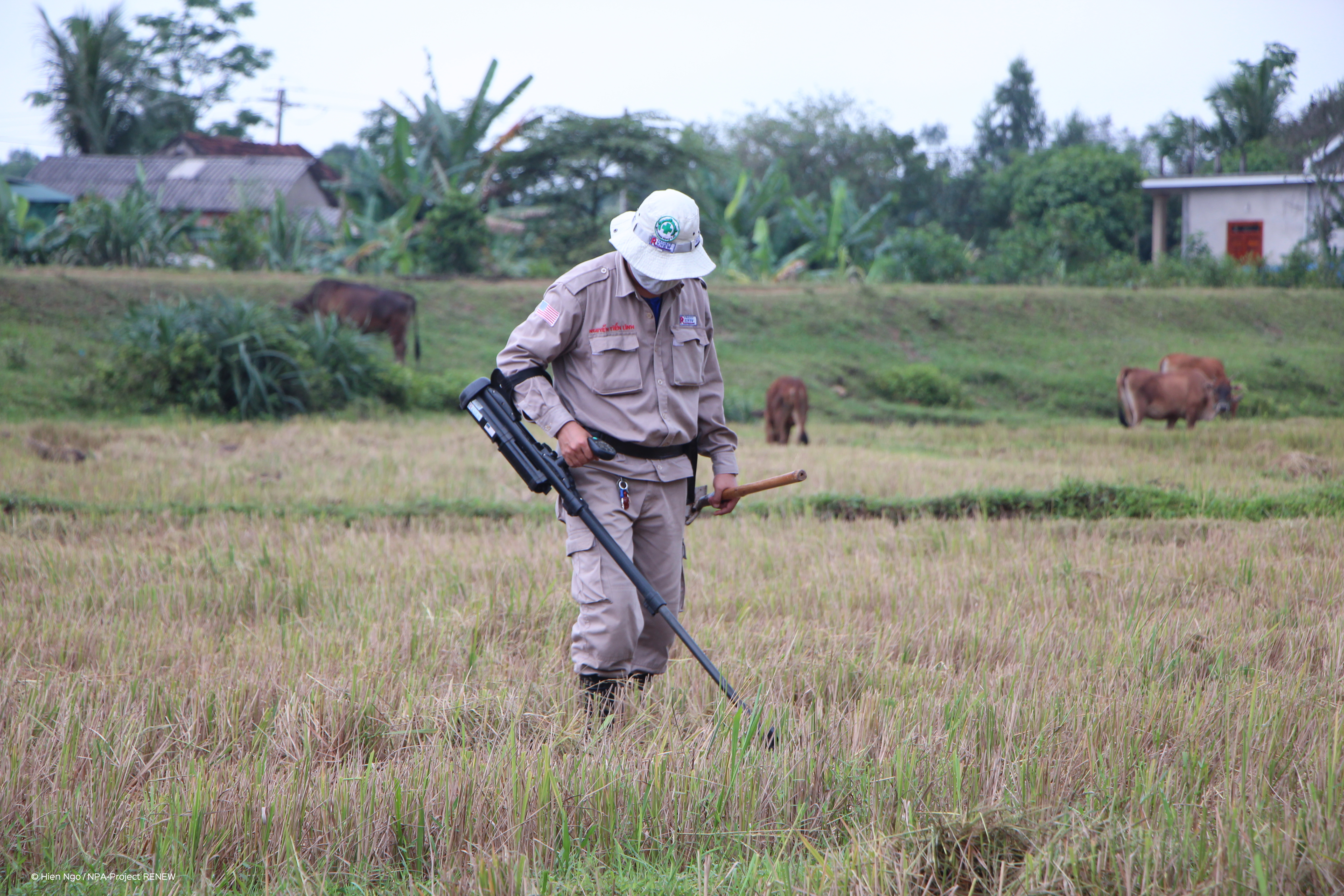
Norwegian People's Aid deminer searches a contaminated agricultural field in Ha Trung Village, Vietnam. © Hien Ngo/NPA-Project RENEW, April 2020
The Anti-Personnel Mine Ban Convention, for example, does not include provisions for tracking or addressing environmental damage. Similarly, monitoring systems such as the Landmine Monitor do not include wildlife injuries or ecosystem impacts in their reporting. Without formal recognition in policy or monitoring systems, these impacts are not systematically measured or addressed, limiting the scope of post-conflict recovery. There has been progress towards integrating recovery approaches, as the Siem Reap Angkor Action Plan developed by States Parties to the Mine Ban Convention in 2024 included environmental considerations
Addressing the environmental impacts of landmines requires expanding current mine-action frameworks to include wildlife and ecosystem considerations. Here are some recommendations:
- Monitoring systems such as the Landmine Monitor should incorporate indicators of wildlife harm, habitat disruption, and ecological recovery to capture the full scope of landmine impacts better.
- Environmental assessments should be integrated into mine-clearance operations, drawing on approaches developed by organizations such as Norwegian People’s Aid, which link clearance efforts to land restoration and sustainable development outcomes. Tools such as the Green Field Tool support the integration of environmental considerations into mine clearance operations by helping assess ecological impacts during planning and implementation.
- International policy frameworks, including the Anti-Personnel Mine Ban Convention, should adopt a more holistic, ecosystem-based approach to post-conflict recovery that recognizes the interconnected nature of human and environmental well-being. Strengthening collaboration with research organizations such as the Conflict and Environment Observatory can further support the integration of environmental considerations into mine-action policy and practice.
Landmines continue to shape post-conflict environments long after active hostilities end, extending their impact beyond human casualties to wildlife and ecosystems. While current mine-action frameworks have made significant progress in addressing humanitarian concerns, important environmental consequences remain unaccounted for. Wildlife harm and ecosystem disruption are not peripheral issues but central to understanding the full impact of landmines.
Addressing these gaps requires more inclusive, ecosystem-based approaches that integrate environmental considerations into policy, monitoring, and clearance practices. Strengthening this approach can support more complete and sustainable post-conflict recovery for both natural systems and human communities. Long after conflicts end, their impact is still felt above the surface for both humans and wildlife.
Do you like this page?